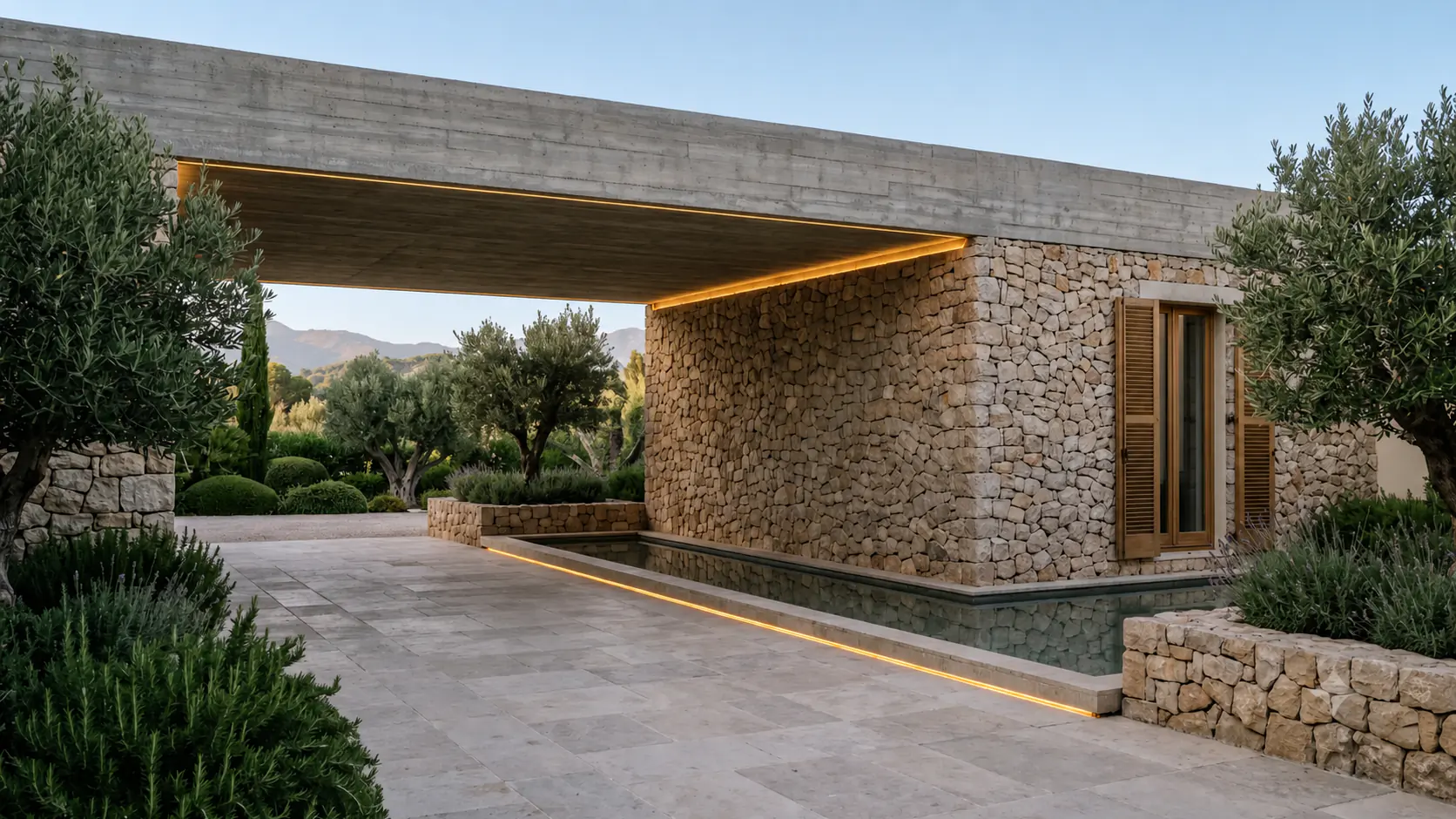
If you want to understand where the top of the European property market is heading, look at what is being built between Marbella and Benahavís. Versace-designed villas in Nueva Andalucía. An Elie Saab tower in Cascada de Camoján. Lamborghini-inspired residences in the Benahavís hills. Missoni at Finca Cortesín. A W Residences project under the Marriott flag. The Costa del Sol now leads Europe in branded residences — and for investors, this is not a curiosity but a structural shift in how the luxury segment prices, sells, and holds value.
What a branded residence actually is
A branded residence pairs private ownership with the identity and service standards of a luxury brand — hotel groups historically, joined now by fashion houses, automotive marques, and design studios. The owner buys a home; the brand provides architecture and interiors to its standard, hotel-grade amenities and concierge services, and professional management. In return, the development typically commands a price premium of 25–35% over comparable non-branded product, a figure consistent across global research from firms such as Savills.
Why the Costa del Sol became Europe’s branded capital
Branded residences need three things to work: a deep international buyer pool, a service economy capable of delivering hotel-grade operations year-round, and land in locations the target clientele actually wants. The Marbella area is one of the few places in Europe offering all three simultaneously. Its buyer base spans more than sixty nationalities; no single market dominates. Its hospitality infrastructure was built over decades around establishments like the Marbella Club and Puente Romano. And its geography — the Golden Mile, the hills of Benahavís, the marina culture of Puerto Banús — provides exactly the canvas brands seek.
Add 320 days of sunshine, Málaga airport’s direct connectivity to over 130 destinations, and the absence of meaningful competing supply elsewhere in Mediterranean Europe at this scale, and the concentration stops being surprising.
The investment case — and its honest limits
What works
- Liquidity at exit. Branded product attracts a global buyer pool that searches by brand, not just by location. In a downturn, this depth matters more than the premium paid.
- Defensible pricing. Recent Costa del Sol launches with credible brands have sold out pre-completion, and resale premiums have so far held rather than evaporated at handover.
- Genuine lock-and-leave. For international owners using the property a few months a year, professional management is not a luxury — it is the difference between an asset and a burden.
- Rental performance. Where rental programmes exist, brand recognition supports occupancy and rate premiums in the short- and mid-term market.
What deserves scrutiny
- Running costs. Hotel-grade service means hotel-grade community fees — often €800–€2,500+ per month. Model them into net yield from day one.
- Brand durability. A fashion label’s cachet in 2026 is not guaranteed in 2046. Hotel-operated schemes with long management contracts carry less of this risk than licence-only design collaborations.
- The premium question. A 30% premium is rational only if the location would be prime without the brand. A strong brand on a secondary plot is decoration, not investment.
Branded versus boutique: the real choice in 2026
The alternative at this price point is the boutique luxury development — small schemes of 20–60 residences with comparable build quality and amenities, without the brand premium. The pipeline along the coast is rich in both. The arithmetic differs: boutique product typically offers better entry pricing per square metre and lower fees; branded product offers deeper exit liquidity and stronger rental branding. For a pure investor, the boutique route often pencils better; for an owner-user who values service and plans a long hold, the branded premium frequently earns its keep.
Most branded and boutique schemes sell off-plan, which introduces its own discipline around payment structures, bank guarantees, and developer covenant — we cover that decision framework in our off-plan analysis later this month. A curated overview of current new-build projects across the coast is maintained at Spain New Developments.
How to underwrite a branded purchase
Treat the brand as one input, not the thesis. The questions that matter: Would this location command prime pricing unbranded? Is the management contract long-dated and with the operator itself? What do total occupancy costs do to net yield? How many comparable branded units will exist within a ten-minute drive by 2030 — and at what point does scarcity become saturation? The Costa del Sol’s branded pipeline is strong but not infinite in discipline; selectivity is the entire game.
For the broader market forces underneath this segment — pricing, supply constraints, and where international capital is flowing — see our 2026 investment outlook and the analytical tools in Market Intelligence.
Access and advice
Several of the strongest branded and boutique launches never reach the open market in volume; allocations move through developer relationships. I help private clients evaluate and access these projects — including the unglamorous work of stress-testing fees, contracts, and exit assumptions. If the branded segment is on your radar, contact me for a confidential discussion of what is genuinely worth your capital this year.