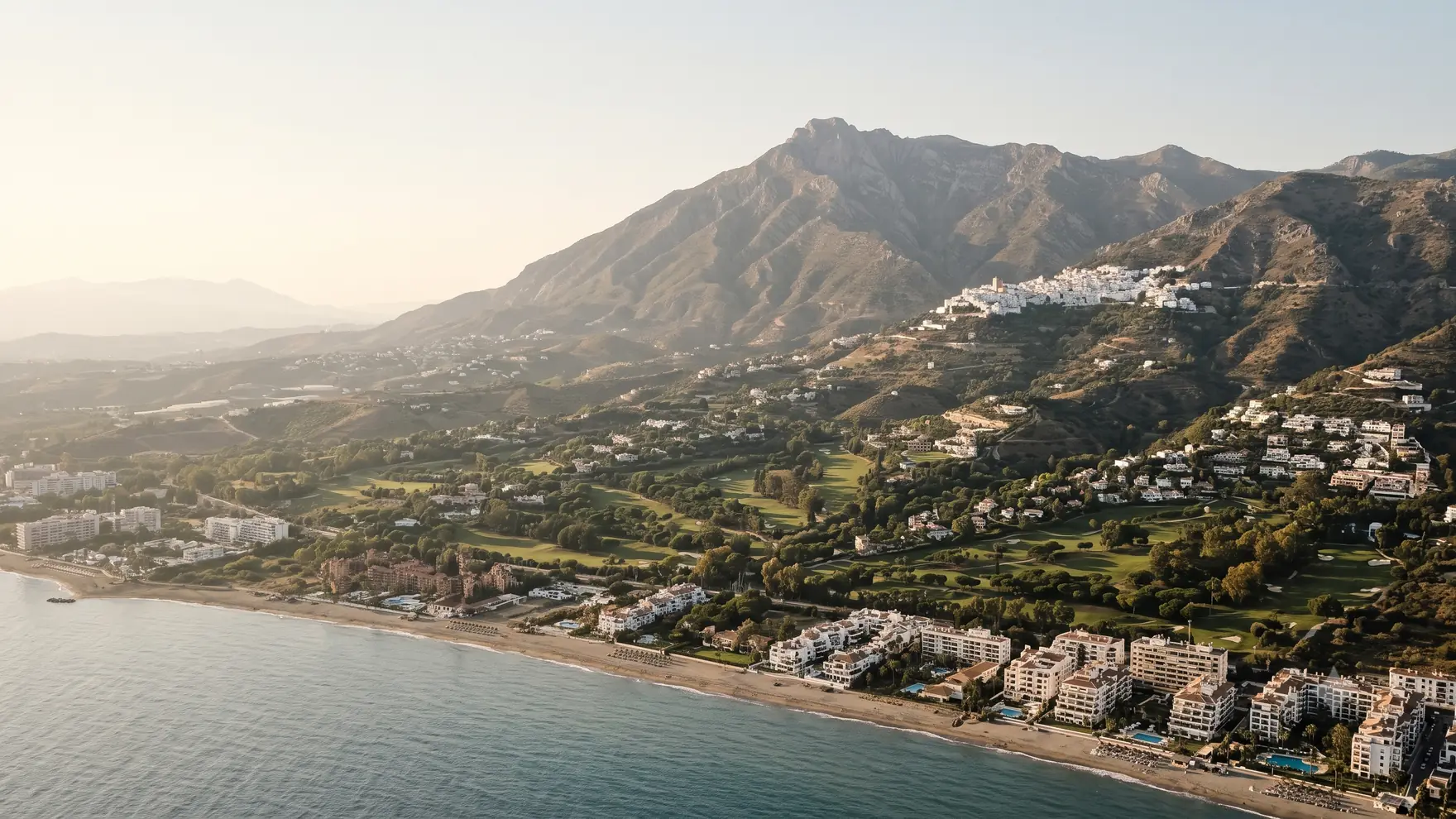
Mijas is the municipality most Northern European buyers reach for after Marbella, and for good reason. It covers 148 square kilometres, runs along twelve kilometres of coastline, and divides cleanly into three very different worlds: Mijas Pueblo, the whitewashed village in the hills; Mijas Costa, the coastal strip where most international buyers actually live; and Las Lagunas, the modern working core beside Fuengirola. The appeal is consistent — walkability, golf, year-round community and genuine value relative to prime Marbella — but the right part of Mijas depends entirely on the kind of life you intend to lead.
This guide maps the whole municipality and points toward the detailed area guides where each neighbourhood is examined in full. La Cala de Mijas and the golf corridor above it are treated as signature areas in this series, because they are where Mikael can speak with the most specific local knowledge.
How to think about Mijas
The relocating family tends to gravitate to Mijas Costa for the combination of beach, schools and walkable village life. The golf-led year-round resident looks to the resort estates inland. The lifestyle buyer who wants authentic Spanish character — and a quieter rhythm — looks up the hill to Mijas Pueblo. And the value-conscious investor reads Mijas Costa as one of the highest-appreciating corridors on the coast over the past five years.
La Cala de Mijas — the centre of gravity
If Mijas has a single centre of gravity for international buyers, it is La Cala de Mijas. In the space of a few years the old fishing village at the middle of the Mijas coast has become the most complete year-round town on this stretch of the Costa del Sol: a real plaza with a working church, a promenade and a chiringuito-lined beach, a weekly market, international schooling within a short drive, and a residential offer behind the seafront that is upgrading faster than anywhere else in the municipality.
What makes it unusual is that it works in February. Much of the coast empties out of season; La Cala keeps its restaurants open, its padel courts busy and its school runs going — which is precisely what buyers who intend to live here full time, or to let the property reliably, are looking for. The international Cala Mijas Festival each summer has given the village a cultural profile it did not have five years ago, and Fuengirola, Marbella and Málaga Airport are all within a comfortable drive.
For buyers the practical question is which part of the village you want: the walkable grid immediately behind the seafront, the newer beachside developments east and west of the centre, or the quieter hillsides climbing toward the golf. Each carries its own price band and its own rental profile. Read the full La Cala de Mijas area guide.
La Cala Golf Resort and the hills above the village
Three kilometres inland from the village, La Cala Resort is the golf estate this part of the coast is built around: three 18-hole championship courses — América, Asia and Europa — designed by Cabell B. Robinson through a genuinely mountainous stretch of the Sierra de Mijas, plus a nine-hole par-three, a hotel and spa, and one of the better golf academies on the Costa del Sol.
The residential side matters as much as the golf. La Cala Hills, Buenavista and the resort’s own villa and apartment clusters offer space, elevation and views that the village below cannot — for buyers who want a plot, a garage and a quiet road, and who accept a short drive to the beach in exchange. It is one of the few places on the coast where a golf-led life is genuinely year-round rather than seasonal. Read the full La Cala Golf & La Cala Hills guide.
Mijas Costa
La Cala and the golf estate above it are covered in full above. The rest of the twelve-kilometre coastal strip runs from the Marbella boundary toward Fuengirola and divides into four further areas.
Calahonda and the western Mijas Costa. One of the original Northern European resident communities — established, well-served, and strong value relative to Marbella, with La Siesta Golf and El Chaparral on the western fringe.
El Chaparral and El Faro. Pine-clad residential hills around El Chaparral Golf, the El Faro de Calaburras lighthouse, and a quiet, protected stretch of coastline for buyers who want calm over bustle.
Miraflores and Riviera del Sol. Established mid-market urbanisations around Miraflores Golf, family-friendly, with a beachfront strip of restaurants — a practical, good-value choice.
Higuerón and the eastern Mijas Costa. The service-led Reserva del Higuerón estate above Carvajal — wellness, sports, branded residences and lock-up-and-leave living — and the sister estate to the new Higuerón Marbella Golf Resort. Fifteen minutes from Málaga Airport.
Mijas Pueblo
The white village in the hills above Fuengirola, with its narrow streets, panoramic terrace looking south toward Africa on a clear day, traditional Andalusian villa stock, and a settled community of long-term Northern European residents. For buyers who want character and a slower rhythm rather than beachfront convenience.
Las Lagunas
The modern administrative and commercial core beside Fuengirola — home to Mijas Golf (the Los Lagos and Los Olivos courses) and the Costa del Sol Hospital catchment. Less a buyer destination than the practical engine that makes the rest of the municipality function year-round.
The golf the municipality is built around
Mijas is one of the most golf-dense municipalities on the coast. La Cala Resort is the anchor, with three 18-hole championship courses of its own; around it sit Calanova Golf just inland of La Cala de Mijas, Santana Golf, Mijas Golf (Los Lagos and Los Olivos), El Chaparral Golf, Miraflores Golf, La Siesta Golf at Calahonda, and Cerrado del Águila near the Mijas Pueblo fringe. Each is examined in the relevant area guide.
The Higuerón connection
The November 2025 acquisition of Marbella Golf Country Club by Higuerón Developments — now being redeveloped as the Waldorf Astoria-anchored Higuerón Marbella Golf Resort — makes the existing Reserva del Higuerón above Mijas Costa the mature sister estate to one of the most watched new projects on the coast. For buyers weighing Mijas Costa, that portfolio context matters, and it is examined in full in the dedicated guides.
Where to go next
Each area named here has its own detailed guide, with golf courses, beaches and chiringuitos, schools, property types, price bands and an honest investment lens. If you would like a shortlist built around walkability, golf, family life or value, that is exactly the conversation to start with a brief, no-obligation discussion.
Ask Mikael for a Mijas Costa shortlist tailored to how you intend to use the property.
Detailed area guides
Head-to-head comparisons: La Cala de Mijas vs Calahonda · La Cala de Mijas vs Elviria. Go deeper into the Mijas coast with the full subarea guides: La Cala de Mijas · La Cala Golf & La Cala Hills · Reserva del Higuerón & eastern Mijas Costa.
Mijas Costa coastal communities
The Mijas Costa coastline runs from the Marbella boundary toward Fuengirola through a string of established communities, each with its own character:
- La Cala de Mijas — the village at the centre of the coast, and the most complete year-round town on this stretch.
- La Cala Golf & La Cala Hills — the resort estate and the residential hills three kilometres above the village.
- Calahonda — the largest, most self-contained community on Mijas Costa, a full-service coastal town.
- El Chaparral & El Faro — the greener, more residential side, set among protected pine forest and the Calaburras headland.
- Miraflores & Riviera del Sol — the eastern seafront, defined by its long walkable promenade and good value.
- Mijas Pueblo — the white mountain village above the coast, all character, cooler air and panoramic views.
Municipal services, padrón registration and local planning information are published by the Mijas town hall.