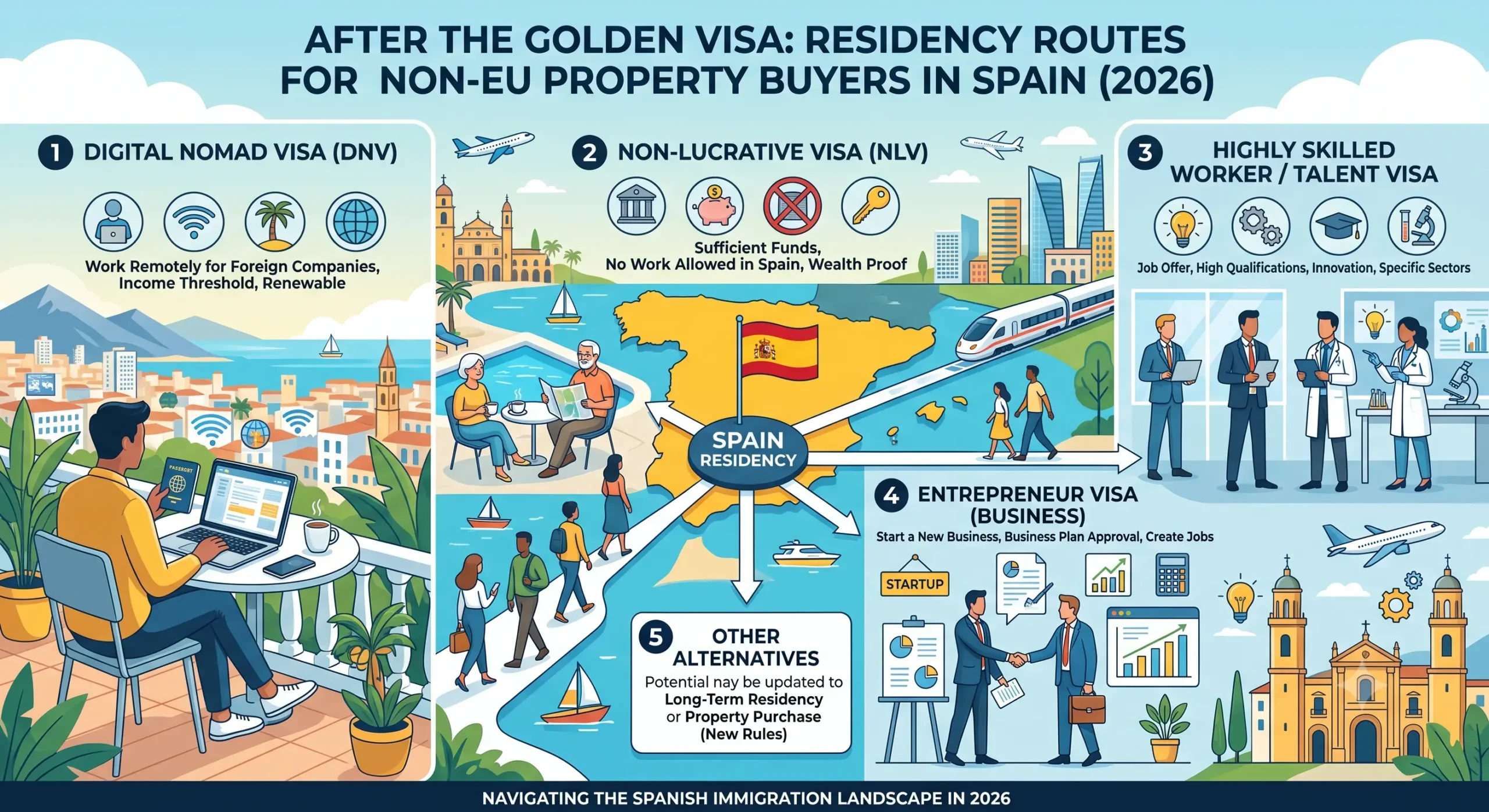
In April 2025, Spain closed the door on its golden visa — the programme that for over a decade granted residency to non-EU nationals who invested €500,000 or more in Spanish property. For international buyers on the Costa del Sol, the change was less dramatic than the headlines suggested, but it did something important: it separated two decisions that used to be bundled. Buying property and securing residency are now independent processes, each with its own logic.
This guide sets out where non-EU buyers stand in 2026: what is unchanged, which residency routes remain open, and how to think about the decision if you are acquiring property here. It is general information, not legal advice — your specific position should always be reviewed with a qualified Spanish immigration and tax lawyer.
What has not changed
Non-EU nationals retain exactly the same property ownership rights as before. There is no restriction on foreigners buying real estate in Spain, no additional approval process, and no differential transfer tax based on nationality at the time of writing. You can buy, own, rent out, and sell freely. The 90/180-day Schengen rule governs how long non-resident owners can stay: up to 90 days in any rolling 180-day period — for many second-home owners, entirely sufficient for a season in the sun split across the year.
What disappeared is the shortcut: property purchase alone no longer generates a residence permit. Anyone wanting to live in Spain beyond Schengen limits now applies under the standard immigration framework.
The main residency routes in 2026
The non-lucrative visa (NLV)
The workhorse route for financially independent buyers — retirees, principals living on investment income, families taking a sabbatical year. The core requirements: demonstrate passive income or savings of roughly €28,800+ per year for the main applicant (around €7,200 per additional family member), hold comprehensive private health insurance, and refrain from working in Spain. The NLV is initially granted for one year and renewable in two-year increments, with permanent residency possible after five years.
For most HNWI buyers who actually intend to spend significant time on the coast, the NLV is the natural successor to the golden visa. The financial thresholds are trivial for this audience; the meaningful difference is that the NLV generally implies becoming Spanish tax resident, which the golden visa did not require.
The digital nomad visa
Designed for remote workers and business owners whose income originates outside Spain. The income threshold sits around €2,850 per month in 2026, and the route can pair with Spain’s special expatriate tax regime (the so-called Beckham Law), which for qualifying applicants caps Spanish tax at 24% on Spanish-source employment income for up to six years and largely shields foreign assets and income. For working professionals relocating with families, this combination is frequently more attractive than the golden visa ever was.
Other routes
Work visas, entrepreneur visas for ventures deemed innovative, student visas, and family reunification complete the picture. For founders establishing a genuine business presence in Spain, the entrepreneur route remains underused and comparatively fast. Official requirements and current thresholds are published by the Spanish Ministry of Inclusion, Social Security and Migration; overviews comparing routes are maintained by relocation specialists such as Global Citizen Solutions.
The tax residency question — the real decision
The golden visa’s quiet superpower was allowing ownership and presence without triggering Spanish tax residency. Its removal means buyers should now make the tax question explicit. Spend more than 183 days per year in Spain — or have your centre of economic interests here — and you are a Spanish tax resident, exposed to worldwide income taxation and, depending on the region and your structure, wealth-related taxes. Andalusia has effectively abolished its regional wealth tax, but the national solidarity tax on large fortunes still applies above certain thresholds.
In practice, we see three clean strategies among our clients. The non-resident owner stays within 90/180 days, keeps tax residency at home, and treats the property as a lifestyle asset with rental optionality. The full relocator commits to the NLV or nomad visa, plans the move with proper pre-arrival tax structuring, and often combines it with the Beckham regime where eligible. The staged migrant buys now as a non-resident, uses the property within Schengen limits, and defers the residency decision until retirement or a liquidity event. All three are legitimate; choosing between them before you buy — not after — is what separates well-advised buyers from the rest.
What this means for the property decision
Decoupling residency from purchase has had a subtle market effect: it removed the artificial €500,000 price cluster that the golden visa created and refocused demand on fundamentals. Buyers now select purely on asset quality and intended use. If your plan involves family relocation — schools, healthcare, day-to-day logistics — our Relocation & Family Life section covers the practical landscape, and our area guides map which communities suit full-time living versus seasonal use.
Whatever route you take, model the full acquisition cost precisely before committing — our true cost of buying calculator breaks down taxes and fees for both resale and new build. And for the broader market context behind the residency question, start with our Costa del Sol investment outlook for 2026.
A confidential conversation
I work with non-EU and Northern European buyers on exactly these questions — sequencing the purchase, the residency route, and the tax position so the three reinforce rather than complicate each other, alongside vetted legal and tax counsel. If you are weighing a Costa del Sol acquisition and the residency dimension matters to you, get in touch for a private discussion of your situation.